
more on EFCF NIGERIA 2026
Afro Streets Exclusive
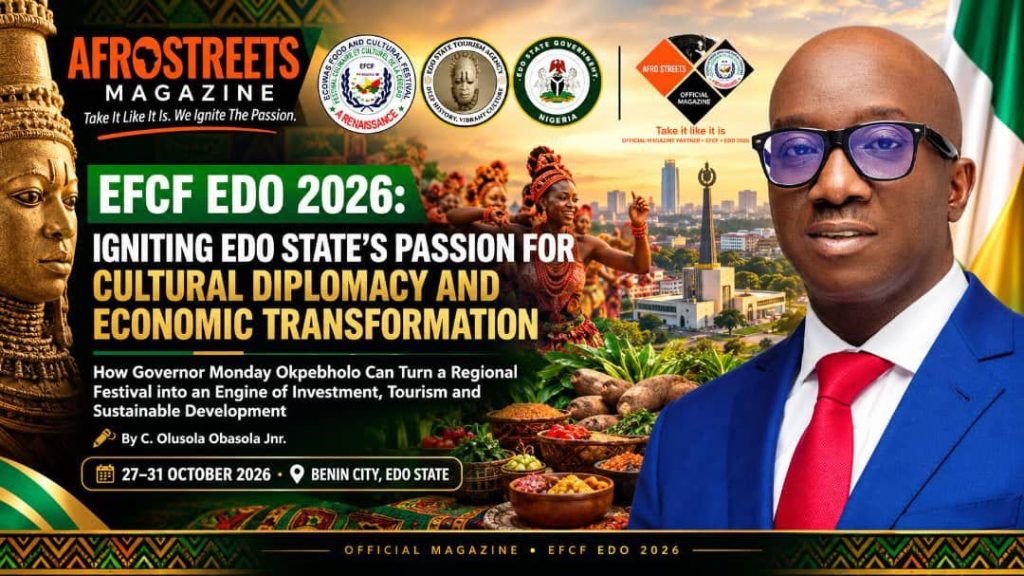
EFCF EDO 2026: IGNITING EDO STATE’S PASSION FOR CULTURAL DIPLOMACY AND ECONOMIC TRANSFORMATION
How Governor Monday Okpebholo Can Turn a Regional Festival into an Engine of Investment, Tourism and Sustainable Development
By C. Olusola Obasola Jnr | Publisher, Chief Content Provider & CEO, Afrostreets Magazine
Beyond a Festival: A Strategic Opportunity for Edo State
The decision to host the 2026 edition of the ECOWAS Food and Cultural Festival (EFCF) in Benin City presents Edo State with an important opportunity to strengthen its economic profile, celebrate its cultural heritage and expand its engagement with regional and international partners.
Under the leadership of Senator Monday Okpebholo, Governor of Edo State, EFCF Edo 2026 offers a platform for connecting cultural identity with economic development, food security with agricultural enterprise, and tourism with investment.
Scheduled for 27–31 October 2026, the festival is anchored on the theme, “African Foods, Cultural Heritage, Peace and Security for Sustainable Development, Tourism and Economic Growth.” Its philosophy recognises that food and culture are not merely symbols of identity; they are valuable economic assets capable of stimulating employment, entrepreneurship, tourism and regional cooperation.
For Edo State, the opportunity extends beyond hosting an international gathering. It lies in transforming the attention generated by the festival into sustainable economic benefits for the government, businesses and communities.
Governor Okpebholo and the Value of Strategic Hosting
Hosting a regional festival of this nature offers Governor Okpebholo’s administration an opportunity to demonstrate how strategic partnerships and cultural diplomacy can complement the state’s development ambitions.
Across the world, major cultural events have the potential to stimulate economic activity by attracting visitors, encouraging business engagement and showcasing investment opportunities. Their lasting value, however, depends on effective planning, local participation and sustained follow-up.
EFCF provides a meeting point for governments, investors, agricultural producers, tourism operators, cultural institutions and entrepreneurs. Edo State can use this platform to communicate its economic potential, promote local products and establish relationships with stakeholders whose interests align with its development priorities.
The administration’s greatest achievement would not simply be the successful organisation of the festival, but its ability to translate participation and visibility into measurable outcomes.
This requires a deliberate strategy that connects festival activities with investment promotion, enterprise development, tourism planning and employment opportunities.
Food Security: Unlocking Agricultural Potential
Food security remains a major development priority across West Africa. Increasing agricultural productivity, reducing post-harvest losses, improving food processing and strengthening distribution systems are essential to making food more available and affordable.
EFCF offers Edo State an opportunity to showcase its agricultural capabilities and encourage investment across the food value chain.
From farming and fisheries to food processing, storage, packaging, transportation and hospitality, agriculture provides opportunities for businesses of different sizes. Connecting farmers with financial institutions, processors, distributors and technology providers could help stimulate productive partnerships.
For Governor Okpebholo’s administration, the strategic objective should be to encourage investors to look beyond the festival’s culinary exhibitions and consider viable agricultural projects within the state.
Such investments could support rural livelihoods, expand markets for farmers, create jobs and strengthen local food systems.
The broader vision is to make food production and processing drivers of economic growth rather than treating them solely as subsistence activities.
Cultural Heritage as a Tourism Asset
Edo State possesses a distinctive cultural identity rooted in the historical Benin Kingdom, celebrated artistic traditions, craftsmanship and enduring institutions.
These assets provide a strong foundation for cultural tourism and the creative economy. EFCF Edo 2026 offers an opportunity to introduce a wider audience to Edo’s history, artistic excellence, cuisine, fashion and cultural experiences.
The potential beneficiaries extend beyond hotels and restaurants. Artisans, traditional performers, fashion designers, visual artists, photographers, tour operators and other creative professionals can gain exposure and commercial opportunities.
In particular, Benin City’s historical significance provides a compelling basis for developing tourism experiences that connect heritage sites, museums, arts, crafts and community traditions.
For these opportunities to endure, the state should integrate the festival into a broader tourism strategy that encourages visitors to return, supports local cultural enterprises and promotes the preservation of heritage.
Edo’s cultural identity can therefore become not only a source of pride, but also a foundation for sustainable economic activity.
Investment, Employment and Local Enterprise
The immediate economic opportunities associated with EFCF include visitor spending on accommodation, transportation, food, retail, entertainment and event services.
Local businesses may experience increased demand, while suppliers and service providers can benefit from contracts connected to festival activities.
The wider opportunity lies in the potential multiplier effect. Money spent locally can circulate through businesses, employees and suppliers, supporting additional economic activity.
Nevertheless, the scale of these benefits will depend on visitor numbers, local procurement, business participation and the proportion of expenditure retained within Edo State.
The festival can also facilitate business meetings, investment presentations and partnerships involving agriculture, manufacturing, hospitality and tourism.
To maximise these opportunities, the state should encourage local suppliers to participate, provide businesses with information about procurement opportunities and establish mechanisms for following up on investment discussions.
Young people and women entrepreneurs should receive particular attention. Their participation in catering, food processing, fashion, technology, event management and tourism services can help ensure that the festival contributes to inclusive economic development.
Strengthening Edo State’s Regional and International Profile
EFCF’s ECOWAS dimension creates opportunities for Edo State to engage with a wider regional community.
West African countries share interests in food security, agricultural trade, tourism, cultural exchange and economic cooperation. A festival that brings these interests together can encourage relationships between businesses, institutions and communities across national boundaries.
Benin City can use this opportunity to strengthen its profile as a destination for cultural experiences, business engagement and investment exploration.
However, visibility alone does not guarantee investment. Infrastructure, institutional efficiency, reliable information and an enabling business environment remain important to converting interest into viable projects.
The festival should therefore complement, rather than replace, the sustained policies needed to attract investors and support enterprise development.
From Celebration to a Lasting Legacy
The true measure of EFCF Edo 2026 will be the opportunities that remain after the festival concludes.
The Edo State Government should consider evaluating outcomes such as local businesses engaged, jobs supported, business partnerships initiated, investment proposals developed and tourism opportunities promoted.
A structured post-festival programme could help distinguish initial expressions of interest from completed agreements and investments that actually materialise.
Connecting successful partnerships to agricultural development, cultural preservation, tourism promotion and enterprise-support initiatives would further strengthen the festival’s long-term value.
Such an approach would provide a credible basis for assessing its contribution to the state’s development and improving future editions.
Conclusion: Igniting the Passion, Building the Future
EFCF Edo 2026 presents Governor Monday Okpebholo and the people of Edo State with an opportunity to demonstrate how cultural heritage, agricultural enterprise and regional cooperation can support sustainable development.
The state’s history provides the cultural foundation; its farmers, entrepreneurs, artisans and young people provide the human capital; and the festival offers a platform for presenting these strengths to a wider audience.
The priority now is to translate this opportunity into practical outcomes: stronger businesses, expanded tourism prospects, agricultural partnerships, employment opportunities and lasting regional relationships.
Edo State is not merely opening its doors to a festival; it is opening a conversation about the future of food security, cultural diplomacy, investment and economic prosperity.
For Governor Okpebholo’s administration, the enduring achievement would be to ensure that the passion ignited by EFCF becomes a catalyst for enterprise, community development and a stronger economic future for Edo State.
EFCF Edo 2026: Celebrating Our Heritage, Strengthening Our Economy and Connecting West Africa to a Shared Future.
AFROSTREETS MAGAZINE
Take It Like It Is. We Ignite The Passion.
Culled from: https://www.facebook.com/share/p/1Ewy8zmiTN/